Friday, June 24, 2011

Meditation and Metaphors

Who hasn't thought about meditating? And why not? I've only ever heard good things about its benefits. Yet, like the author of Eat, Pray, Love, learning how to do it presents problems. Emptying ones mind of thoughts is nigh impossible. And if you do happen to do it, for like one second, then what? So, when I was invited to join a beginner's class in meditation about six months ago, I was happy to try it, and it has turned out to be a very meaningful part of my life.

There are many kind of meditation, but the one I've been introduced to is Taoist. According to my instructor/leader, "The Taoist practice is based upon cultivating a surrendered relationship to one's own intuitive knowing, and using energy in alignment with that to help/heal oneself and others."

So, what have I learned? How to sit, how to bow in, how to position my hands, how to calm the mind and "stop the tapes," how to breathe, how to listen, how to focus on different important points in the body, how to make an intention, how to "read" another person, how to give energy as well as receive it, how to experience the many levels of depth in meditation, how to love it. All of this in just about a dozen sessions! It's pretty amazing, and I'm sure this is just the tip of the iceberg. I'm still just "Beyond Beginners."

Like many things, meditation is very personalized. People come to it for different reasons, they experience it differently, and they take different things away. I didn't know what to expect, or what I wanted to get out of it, so I quickly made something up like "focus and direction" when asked about that. I'm not sure that's what I've gotten, but I have gotten many other things: acceptance, calm, energy, enlightenment, patience, and knowledge, for instance. I've learned that there are many layers to meditation, from thought to emotion to energy to spirit to connection to the universe. I've learned that you let it happen; you don't force it. Emotions will spill out when the boxes you have locked them in open. It's useful to just "sit with" the feelings and see what happens. I've had tears streaming down my face at times without even knowing why. Deep joy and deep sadness have both visited me. Energy can be transferred to another person. I've done it and it doesn't deplete my own. In fact, I feel more energized. It is possible to see and feel things about other people and for them to do so for me. No matter how long I meditate, when, or where, it's always helpful. The more I practice it, the more I learn.

Meditation is made up of metaphors, signs, and symbols. They might be colors, a feeling (warmth, pain, etc.), movement (in my case, lots of it), sound (some people are very vocal with spontaneous sound), places (a basement, the ocean, a mountain), images (light, figures, animals, water, a rainbow, a dog). It's amazing because they are not forced; they just appear. The challenge might be to make sense of them.

One little story: One time I was meditating with another person, touching back to back. Several things appeared to me, but one particularly odd one was cowboys. Several times, cowboys appeared in front of my mind. (Note: I never think about them.) When I shared this with the other person, whom I barely knew at all, I expressed my puzzlement. She said it wasn't surprising to her, at all, because her family came from Oklahoma and was filled with cowboys and Native Americans! Don't know how/why that happened, but it's pretty cool. Maybe I'll get a job at the Renaissance Festival next year.

Saturday, June 4, 2011

The Demise of the Martini

I learned to like martinis from my dad. He could shake up the perfect martini for a pre-dinner cocktail and make it look easy as pie. I think that's part of what made it easy to drink, too. Now, I'm talking about real martinis--with gin and vermouth and olives--not these silly fake ones that they call martinis. It's often difficult nowadays to get an original martini at a restaurant or bar. They keep trying to pass off drinks with chocolate, pomegranate, lemonade, and who knows what else as martinis. They often have no "real" martini on the "martini menu." How did this happen?


I blame it on marketing, of course. (Sorry, Jack.) People like the "idea" of a martini. They like the sound of it. They like the fancy glass it is served in. And they like sweet and pretty drinks for nine or more bucks each. Yes, it's the "martini personalized experience" that people want, not the gin, vermouth, and olives.


So, I find it hard to get a real martini these days. More often than not, the bartender messes it up and I have to return it. It started a few years ago at a so-called American on-base bar in Sigonella, Sicily. Unfortunately, the bartenders were Italian. They used sweet vermouth instead of dry and had no olives to boot! I got fed up, went to the commissary and came back with a jar. At that time, I forgave them, for they were Italians, and what did they know about martinis? I found that several of my female friends there were also martini lovers, AND they knew how to make them perfectly! So we had several TGIF "real martini" parties in Sicily, complete with the vermouth sprayer, chilled glasses, gin, and, of course, olives! (See photos!)

Recently, I've had to send back a lot of martinis, it seems. One place gave me just gin (no vermouth or olives). Others fail to add the olives (it's not a martini without). Many forget the "rocks" and try to serve it to me "up," which is never what I order. So, what is it? Untrained bartenders? Inattentive waitpeople? I'm not being clear? I would estimate the amount of time I actually get what I ordered on the first try to be about 50%. So, not only is it hard to find a "real" martini, but it's as hard to get one!

Mosaics and Metaphors

I don't remember when and where I first became enchanted with mosaics, but it happened sometime between 1990 and 2000. Was it the first time I saw original Roman mosaics, or Byzantine, or Arab? Was it Tunisia, Turkey, Cyprus, Aqueleia near Venice, the Vatican, Pompeii, Bath (England), a German museum, or another place? I went on to search for the really important ones, driving from Germany all the way to Ravenna, Italy, for a weekend to see the "City of Mosaics." I searched out the Chora in Istanbul and stood in awe of these ancient Christian mosaics inside a church-turned-mosque-turned-museum. In Rome, I tracked down obscure churches with the oldest mosaics. When I moved to Sicily, I was lucky to be near the famous UNESCO Roman site of Villa Armerina (more photos HERE) and the Monreale Cathedral near Palermo, as well as dozens of other mosaic masterpieces on the island.

Anyway, at some point, I became interested in doing mosaics, perhaps when I saw different instances of their being repaired or created. There is little time for doing anything when you are a full-time teacher, but what a great idea for retirement! Luckily, I retired in Atlanta, a city of 5 million, where one can find classes or lessons on just about anything. Mosaic beginner classes were found, and early in 2010, I began.

So, it turns out, mosaics are like soccer--easy to learn, impossible to master. The good points about it are (1) there is no "perfect," (2) it's okay, even good, to break things, and (3) you can mosaic anything rigid (except people). Some people don't even have a plan or design when they start; they just let it evolve as it happens. Basically, you stick things (tile, glass, stones, broken plates) to a rigid surface (which can even be rounded, like a flower pot), and then fill in the spaces between the pieces with "grout." Grout makes everything look better, even almost professional.


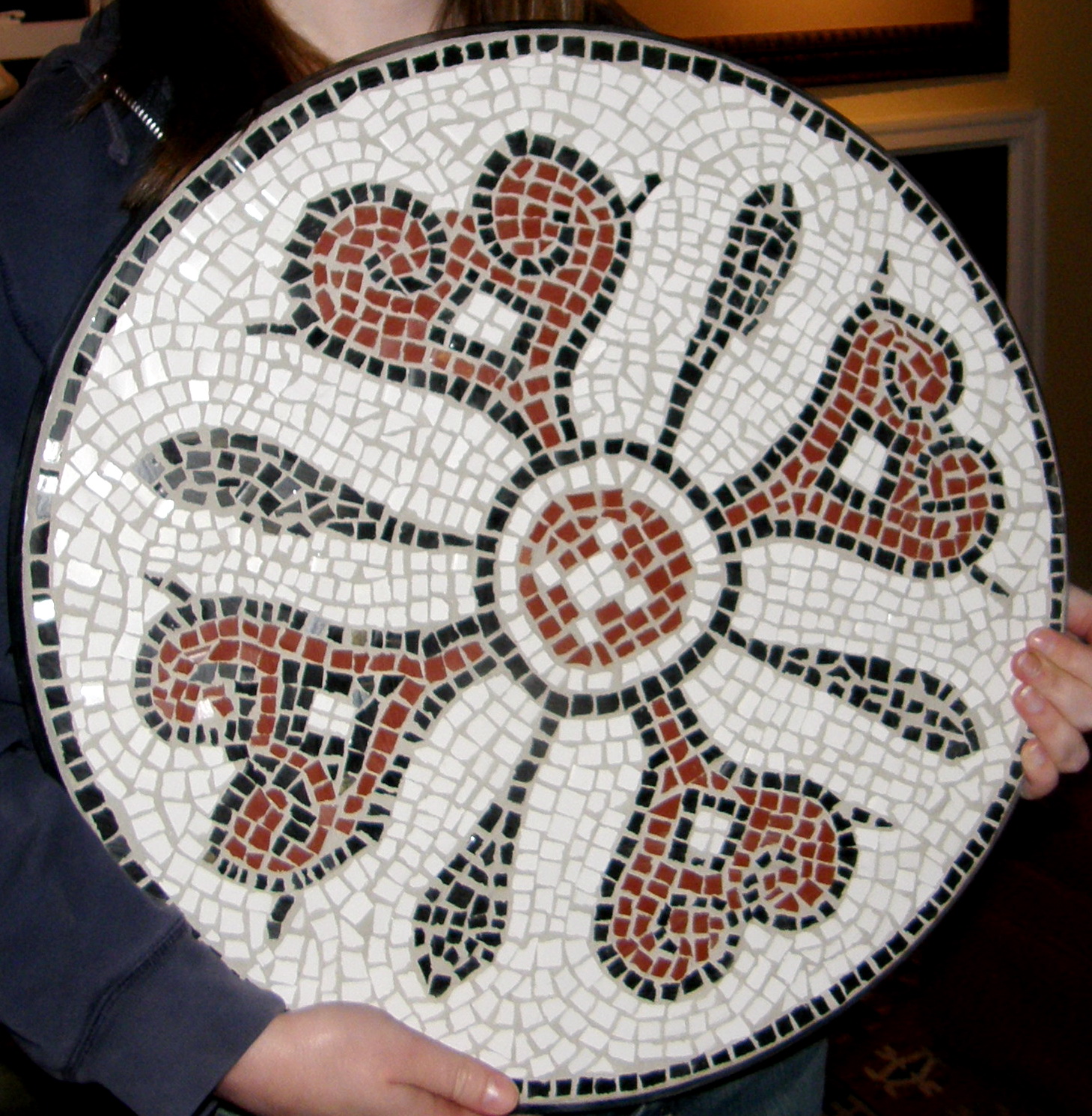
I take my mosaics classes at the Spruill Center for the Arts, and I actually travel OTP (outside the perimeter) for them! In Atlanta, that's like going to the outer limits of space. Spruill, however, is just a big outside the perimeter, and it's such a great place, it's worth the driving adventure. I have hugely enjoyed the laid-back, non-threatening atmosphere of the class, the knowledgeable and supportive instructor, a wide range of classmates, and the satisfaction of learning and improving with each project. I have completed about six projects and am increasingly happier with each one. I am most interested in re-creating the old Roman designs I have seen and photographed, like this tabletop that I made most recently.

When I was teaching in Sicily, I took my AVID (college prep) students on a field trip to the famous mosaics at Villa Armerina. Upon our return, I engaged them in writing a metaphor essay in which they compared their lives to a mosaic. The results of that trip and writing lesson were fabulous. See a brief article HERE. And perhaps that is what draws me ultimately to mosaics. You take a lot of little pieces and put them together into something meaningful. I hope that when the mosaic of my life is done, it has meaning, too.

Small segment of wall mosaic at Monreale, Sicily.

Thursday, May 5, 2011

Squares of Savannah

Savannah, Georgia, is a place I've been wanting to visit for years. Recently I spent a few days there with my friends Elsie and Michael and was not disappointed. In fact, I was charmed by what I can only call its "Europeanness:" the cobblestones, the wrought iron, the history, and especially the squares.

Savannah is famous for its historic houses, shaded streets made of brick or stone, and Spanish moss, but they all are mere decorations for the twenty-four squares that anchor the city. They started out as four squares in 1733, one for each ward, and were originally used for military exercises. As the city grew, more wards were added to the grid and a square with each one. The streets are laid out such that traffic flows counter-clockwise around each square, functioning as a traffic circle of sorts. The squares are fairly uniform in size, too, all measuring roughly 200 feet from north to south and ranging from 100-300 from east to west. They are named mostly for famous people (generals, politicians, royalty, Indian chiefs) and many have monuments or statues to these people. But that doesn't take away from the huge, shady trees and beautiful flowers and shrubbery. You can take an internet tour of all the squares HERE.


But it is the green space and its use of it that make so charming and unique and European. You can walk all the squares of Savannah or view them from one of the many city tours. Walking is best, because then you get into each square and become like a local. We saw people walking, reading, daydreaming, drawing, kids playing a game at recess, and everyone was relaxed and in synch with their city. There is nothing like this for me to walk to and sit down in Atlanta. Oh, there are parks, many of them, and some very large, but there is not a shady, peaceful square every two or three blocks. How many cities can boast that? I don't know of any but Savannah at the moment.


Everyone drives everywhere in Atlanta (adding to the traffic problem) but in Savannah, people still walk or ride bikes, making it a much more pleasant place and pace. I parked my car when I got there and did not use it again until I left the city, much like many places in Europe (Berlin, most recently). The historic district is all strictly protected and changes cannot be made without a "Permit of Appropriateness," thus ensuring against the visual litter of most cities. They can do whatever they want on the inside, but the exterior must match the neighborhood. Savannah was the first American city planned around public squares. I hope it's not the last.

Tuesday, April 5, 2011

"Happy Days Are Here Again" or Where to Find Happiness in a Red State


"Happy days are here again" is inscribed on a shot glass along with a picture of Franklin Delano Roosevelt that I bought last weekend. The cashier in the FDR Museum gift shop said, "There are two stories behind this shot glass, you know." I knew the first one--that was the song title of FDR's presidential campaign, and it is still played at Democratic conventions and election celebrations. The second story had slipped my mind--Prohibition was repealed during FDR's presidency. "Oh, yes," I told the cashier, "I have a photograph of my grandfather, who ran a tavern, with a portrait of FDR proudly displayed behind the bar." She said, "Oh, my, that gives me goosebumps!"

So, there is a soft spot in my heart for Roosevelt and all he did to lead the country out of Prohibition, the Depression, and through World War II. He died unexpectedly of a stroke on April 12, 1945, just as the Allies were racing to Berlin. The newspaper that day shows the map of Europe. We had already taken Wuerzburg; the Nazis still held Nuernberg. The headline proclaims: "57 Miles From Berlin." This paper is one of the many interesting artifacts at the FDR "Little White House" and Museum in Warm Spring, Georgia, about an hour and half south of Atlanta. The FDR State Park and the Roosevelt Warm Springs Rehabilitation Center are also nearby.

In fact, it was the natural warm springs that drew Roosevelt here to Georgia in 1924 in hopes of finding some relief from his polio. He bought the property, built pools and a treatment center, and then had a small house built. It was completed in 1932, when FDR was governor of New York. He continued to go there often during his four elected terms as president, which is when it became known as "The Little White House." And is here that he died.

The house, guest house, and servants' quarters are all preserved exactly. It's hard to imagine a president of the United States staying often in such humble surroundings. It reminds me very much of a modest vacation cottage one might rent in Wisconsin or Michigan--a tiny living room, three small bedrooms, dining room, kitchen and foyer, certainly not more than about 1,000 square feet. The interior is pine paneling and floors. There are four single beds. There is a large semi-circular patio off the back, overlooking the Georgia pine woods. Except for the Marine sentry shacks and one for the Secret Service, nothing would indicate a president lived there. That and FDR's indoor wheelchair.

There is a nice little FDR museum and a separate room dedicated just to the day he died. The museum has some great memorabilia, from FDR's swimming outfit to his 1929 Ford convertible that he drove himself. It was specially outfitted with hand levers for the crippled president. It's actually a real nice overview of FDR's personal life on a smaller scale. Photos of FDR are displayed with some of the artifacts, making them even more real. The so-called "Unfinished Portrait," for which FDR was sitting the very day he died, is on display, along with the cook's lunch menu for the day and the Atlanta Journal-Constitution.

Although it is well off any beaten path, there were quite a number of visitors there on the Sunday I was, many of whom were foreign visitors. One of the displays in the museum shows three presidents who have visited the site (all Democrats, of course): President Kennedy, President Carter (who launched his campaign there), and President Clinton.

With such a huge historical Democratic presence in the county, I wondered how they voted nowadays and if FDR still had influence there. I came home and looked up the last presidential results, the one won by Democrat Barack Obama in 2010. Georgia is, of course, a "red" (Republican) state these days. Warm Springs lies in Meriwether County (pop. @ 22, 000). Obama earned 47% of the votes, losing narrowly to McCain. It's hard to fathom how that happened, and I'm pretty sure FDR isn't happy about it.

Tuesday, February 15, 2011

Sweet Auburn Curb Market

I had been to the DeKalb Farmers Market and the Buford Highway International Market but never heard of the Sweet Auburn Curb Market until I was recently invited there by someone new whom I met. Mickey wasn't just another customer there; she actually worked one day at week at the market helping a friend with a business there. So, she has an insider's view of the Curb Market, which is where I got most of this information.

It reminded me immediately of a smaller version of markets I'd seen in Boston, Baltimore, and Helsinki, with an assortment of butchers, bakers, candlestick makers and places to eat as well as fresh produce and a pharmacy. It has been around since 1918, first in a massive tent, and then in the building it still occupies, at 209 Edgewood Ave. SE near downtown Atlanta. At the time it was established, it was at the geographic center of Atlanta. Today, it's a quiet neighborhood (as quiet as it can be underneath I-75/85) near Georgia State University and Grady Memorial Hospital and adjacent to the Auburn Avenue/Martin Luther King, Jr. district.

It's a dichotomy, a market "in transition" in a neighborhood "in transition." That's a popular phrase here in Atlanta used to describe "sketchy" places. Anyway, it's perfectly safe and a fun place to go and hang out and shop and have some great food. It feels like you are going back in time except for the organic shops, restaurants, and coffee shop. Therein lies the dichotomy, and so the market it teetering on the edge, deciding if it has to be one thing or the other or if it can be everything to everybody.

Some of the newer "organic" businesses are having a tough time, and several have gone under. Yes, organic does cost more. Does the market have the customers to support it? Does it have the marketing? Can it? Can it compete with the bigger ones? Should it?

While the building is a classic from the early 1900s, it could perhaps draw more business, especially for the new vendors, with some renovations and improvements. A facelift, inside and out, better signage, improved parking, to start with, could only improve the "experience" of visiting the market, which should be part of the marketing campaign.

I will say this--I have never been able to find real Georgia peaches in the other markets or the supermarkets. So, where do they go? Maybe, just maybe, I will be able to get them here at the Curb Market.


Organic, authentic, delicous Italian food at Ciao Bocca!

Friday, January 7, 2011

Alles in Ordnung

On a recent trip to Germany, I was reminded again of German law and its long arm in the lives of people living there. This would never fly in the U.S. of A. where "individual rights" reign above all!

In Germany, if you have a sidewalk, you must shovel it free of snow by 7 A.M. so that people can walk to work or wherever. In Atlanta, (1) it rarely snows, (2) no one has a snow shovel, and (3) even if they did, just try and make them use it! Ha! "I don't want to" or "I don't have to" would be common responses (and those are the polite ones).

Germany has a number of "pet laws," including one that requires you to walk your dog every day for at least an hour. This would never fly in Atlanta, where dogs are left on their own in yards, on chains, or in the house for as long as the owner wants. Yes, there are many "good" owners who walk them, but they must be a minority, certainly less than half. My daughter had a neighbor in Augusta, GA, who moved and left the dog in the yard (he had a doghouse). The house remained empty and the own came once in a while to feed the dog. Sad, very sad.

One of Germany's newer pet laws requires the owner to secure a dog that is riding in a car with either a barrier between the dog and the driver or a leash and collar that are attached to the back seat, like a seatbelt for dogs. Much safer, don't you think? But in Atlanta, dogs ride in the back of pick-ups, in the front seat, or even on the driver's lap if they want.

Germans have laws for everything: you must wash your windows inside and out twice a year, refrain from hanging out laundry, washing your car, or cutting the grass on Sunday (a day of rest), and you can't have your car running if you are not in it (no matter how cold it is). There are hundreds more, and everything runs predictably and logically. But we American have the right to be noisy, disturb our neighbors, have dirty windows, and warm up our cars (and the air), don't we? It's good for us, so who has the right to regulate such things? They also are required to recycle by law. Five or more different containers to collect your trash and specific times and places to dispose of them. We are lucky to get people to put trash IN the compactor here.

"Alles in Ordnung" means "everything in order," which is very un-American.

Wednesday, November 24, 2010

Another Cultural Revelation: Krystal Pups


The American South has quite a number of franchise eating establishments that are famous in their own right: Chik-Fil-A, Waffle House, Checkers, and Krystal, come to mind immediately. I love Chik-Fil-A's chicken sandwich, peppermint shakes at Christmas, and (did you know?) their chicken soup. Waffle House is unbeatable for pecan-laced waffles, hash browns (scattered, smothered, and covered), and the only grits I love to eat! Checkers has the best chili dogs and everything take-out. Krystal was the only one I had yet to try.

I had heard that Krystal had mini hot-dogs, something like sliders, but in hot dog format. Now, I love hot dogs, so I was eager to try these out. Yes, Checkers has the best chili dog, but . . . I could not resist the idea of three little hot dogs. So, today, I had the opportunity to finally visit Krystal and try the mini hot dogs, which are called "pups." They come in three's, nestled together in a little rectangular paper tray, cute as can be! You can get them plain, with cheese, chili, or both. And they were as delicious as they were cute! Three or four bites, and one was gone! What a brilliant idea, Krystal! I told the counter boy/teen that this was our first time to have them. He asked where we were from. "Illinois," I answered! He had no reply for that. Illinois is missing out on something. With a little research, I found that Krystal originated in Chattanooga, TN in the Depression and is a "Southern thing." A good one.

Monday, November 22, 2010

Eavesdropping in America


Eavesdropping is something most people don't think about, even though they do it all the time. But, if you live in a foreign country and you don't speak or understand the language very well, you unlearn it. I lived for over twenty years in Germany and Italy and only had a little grasp of the two languages, even after taking courses and living there for so long. Never mind the reasons why, it just happens when you work and socialize with other Americans most of the time and your German and Italian friends happen to all speak perfect English! That's why they are your friends!

Anyway, you quickly stop even trying to eavesdrop, because it's all just blah, blah, blah or perhaps blacht, blacht, blacht or blimini, blimini, blimini! And I'm not kidding! Other people's conversations just become white noise when in restaurants, shops, or any public place where you hear these things.

Okay, so upon returning to the USA, where I actually speak and understand the language, I am a bit surprised to suddenly be able to hear and understand what used to be white noise. Throw in people talking in public on their cell phones, and it's a real circus! I think the ones I dislike the most are the ones with bluetooth devices who walk around talking to themselves.

Mostly, I'm surprised at the shallowness of the conversations, although I'm sure these things are really important to them. In my athletic club, there is a lot of social climbing and catty remarks by the younger women. They don't seem to have a lot of good things to say and even fewer important things. It's really small small-talk.

While I'm working out, there are always trainers working with people. Those are the funniest conversations. The older women, I swear, just have a trainer for someone to talk to. They do very little actually lifting or exercising and a lot of personal conversation with the trainer, usually a younger female. The men talk about girl/women troubles with their male trainers. The serious ones don't talk much at all. If there does happen to be an interesting conversation, I have to fight the urge to jump in . . . because I understand what they are saying about, say, Italy or education.

Just remember, we all can understand what you are saying! I kind of miss the days of blissful ignorance in Europe.

Sunday, September 26, 2010

Wo ist mein Schnitzel?

"If I want a good schnitzel, I go home and make one," said my hair stylist Soeren Loeffler, who is from Germany and not about to waste his time on bad food, wine, beer, or cars. We were bemoaning the lack of a good German restaurant in Atlanta or environs. Like me, he has been to Helen (aka as "the fake German town") in northern Georgia and found the food as laughable as the town itself. Chattahoocheestrasse? Half-timbered Dairy Queen and SunTrust Bank? Live tarantula gallery?

So, when a new German restaurant, Der Biergarten, opened recently in downtown Atlanta by the Aquarium, I was eager to try it out. So, my friend Elaine and my daughter Alison and I went for lunch on a recent Sunday. We thought it was a good sign that several German-speaking groups were leaving as we arrived. The outside terrace was also promising--authentic German fest tables, flags, and signs. However, it was too hot to sit outside and so we went on in . . . to find a very non-authentic (but air-conditioned!) restaurant that looked like it might have been a minimalist Asian sports bar. Although they were out of several items, the service was friendly and fast, the beer was good (real German beer in real German beer glasses), the food was not bad. Alison thought probably the only authentic German person in the place might be the chef. We had decent O'batza (cheese ball) for an appetizer, wurst, red cabbage, potato salad, jaeger-schnitzel (with mushroom gravy), and spaetzle which were all good. No chance for dessert; they were all sold out. Our recommendations for them:
  1. Get better outfits for the wait-staff than t-shirts and jeans.
  2. Get someone to work there who at least looks like they might be German.
  3. Teach them a few phrases in German or get someone who can speak it (we think they may bet a lot of German tourists).
  4. Have available what's on the menu.
  5. Get authentic beer coasters.
  6. Get some German decor! (I have enough in boxes to decorate the place!)
  7. Play oom-pah music instead of classical.
  8. Put EuroSport on the big screen televisions.
  9. Put the menu in both German and English with more explanation.
  10. Sell souvenirs.
  11. Hire Alison and/or me as a consultant.
So! (Popular German word!) Just one week later, I found myself going with my neighbor Patsy to a German Fest at her favorite local restaurant, Petite Auberge in our neighborhood. Although it has been there a million years and has a French name, it is owned by Germans and this fest was way better than Der Biergarten experience! It was jointly sponsored by the Atlanta German Cultural Center and they had games, decorations, German beer, great food (extensive menu), wonderful German band, a beer garden, souvenirs, and lots of people dressed in real German (Bavarian) clothing including lederhosen! It was wunderbar! Unfortunately, it lasts only two days in September each year, but they are hosting an Oktoberfest Buffet on October 23 ($35 for all you can eat, plus the band, cash for German beer and wine). It's got to be good if this night was any indication.

So, does Atlanta have a good German restaurant yet? No, but there is hope. One can always drive 130 miles to Augusta and eat at The Augsburg Haus. Now, there is real German food! They recently moved to a new location, so I don't know if it's as cute as the old one, but hopefully the food and beer are just as good. I've eaten there a couple of times and really love their Roulade (Beef steak roll stuffed with bacon, pickle, onion, and mustard and served with spaetzle and red cabbage).

Guten appetit! (Below, real Nuernberger bratwurt and kraut in Munich)

Thursday, April 8, 2010

Easter at the Monastery

I wanted to find a special place to attend Easter Mass when my daughter Alison came to visit last week. I found a cathedral, a basilica, a university chapel, and a Trappist monastery. Alison chose the monastery, and it turned out to be a wonderful experience for us.

Atlanta is, of course, in the Southern Bible Belt, so there are hundreds of varieties of Protestant churches around, predominantly Baptist. In fact, on our way to the monastery, which was about forty-five minutes away, we passed many other churches, one with its own traffic cop and traffic jam. Eventually, though, we arrived at the entrance to the monastery, way out in the country by the town of Conyers, Georgia.

This particular monastery, called the Monastery of the Holy Spirit, was founded by Trappist monks in 1944. How it came to be in this place with very little Catholic presence can be found on their website. Today, forty-some monks live, work, and pray here.

I didn't know anything about Trappist monks, so I did a little research. They are an offshoot of the Cisterians, and they follow the Rule of St. Benedict. There are are only 170 Trappist monasteries in the whole world and only fifteen in the United States! So, they are pretty rare breed of monks (about 2,100) and nuns (about 1,800). Their job is to pray and work. They pray a lot, beginning at 4:00 in the morning with vigils and then another four times during the day. They also talk very little. Idle talk is "strongly discouraged," they do not talk during meals (but rather listen to readings), and the Grand Silence begins at 8:00 P.M. for all, even visitors.

Like other monks, they "live by the work of their hands." This particular monastery operates a thriving retreat business. Also, "The monks of Holy Spirit manufacture and sell bonsai supplies either online or at their monastery bonsai garden store. They also operate a green cemetery located in a secluded section of the vast monastery property. Stained glass windows and doors are created onsite and sold online and the monastery also operates a fruitcake and fudge business. Their fruitcakes are sold both through their own religious store and also through Honeybaked Ham stores." You can see their website www.bonsaimonk.com.

Okay, so back to the Easter Mass . . . the 11:00 service was full but not crowded. People have to drive quite a distance to get there, but there were families and people of all kinds. We were allowed to sit in the actual monks' benches since they had sung at the 4:30 sunrise service. That was very cool, because I had only ever seen them, never sat in them for a service before. All of their many binders of music and readings were neatly laid open at each place. In fact, it was very AVIDY with all those binders, which kept them organized! (See photo below.)

At least twenty of the monks attended this Mass and sat up on the altar. It was amazing to hear them sing parts of the Mass. I would really like to come again and hear the entire group together. Everything was slow, peaceful, smooth, and spiritual, with lots of incense, singing, and reverence. No cell phones, no talking, no distractions. To us, this was the perfect Easter Mass in the perfect setting. Outside, the sun was shining and everything was in bloom. We left with a promise to return again another day.

Sunday, March 14, 2010

Facebook Parents

There's a new fanpage on Facebook: I was gonna post a status, Then I remembered I have family on faceboook.

This is pretty amusing, because there are so many kids and parents on Facebook these days, and their interactions then become public! I saw two very funny ones last week between mothers and their kids at college.

FACEBOOK EXCHANGE #1:

College age son posts a photo of himself sitting in the snow in shorts and writes, "What to do with the whole campus to myself" or something similar.

Mom's response: "Okay, so why are you wearing shorts in the snow?"

FACEBOOK EXCHANGE #2:

College age daughter: " (Daughter) feels like death..waiting for cold medicine to work its magic!"

Mom's response: "Go to the doctor."

I can laugh at these things because my own kids are older now, but if they were still in college and I was on Facebook, I would most likely be like these parents! I can get away with an occasional comment or "LIKE" now, but they are 25 and 30 and not so bothered by it.

I've also seen some funny sibling exchanges like this one:

College age boy: "(Curse word) something . . . "

High school sister: "I'm going to tell dad!"

College age boy: "What's he gonna do? I'm here and he's there!"

Facebook is the ultimate reality show. You can peep in hundreds of people's lives including family members. No wonder it's so popular. I heard that Facebook has enough members to be the world's fourth largest country!


Kool Aid Shakes?


"1/2 PRICE Happy Hour Day & Night! All shakes & drinks weekdays 2-4 PM. And now 2-4 AM!" That's the latest on a page of coupons from Steak 'n Shake, a chain for which I used to have respect. But it goes on to advertise "New! Tropical Punch & Grape Kool-Aid Shakes" Can you think of anything worse than a Kool-Aid Shake? Does that in any way make you want to run to Steak n' Shake and get one?

It's not that I have anything against Kool-Aid. It was a perfectly fine child-drink for me, just like Tang (have you tasted that lately?). But then, we also ate Pixie Sticks, chewed plastic lips and mustaches, and ate the sugar buttons off the strips of paper. We even sold Kool-Aid on the sidewalk on hot days. Kool-Aid stands were the lemonade stands of rural Illinois in the 50s.

Back to shakes . . . isn't a shake made of ice cream and normal flavoring or maybe fruit? How does Kool-Aid, which is basically sugar and water and color, fit into that?

Perhaps worst of all, Steak 'n Shake is supposed to be an expert on real, creamy, hand-made shakes. It says right on their website: "Hand-dipped, real milk, and classic flavors, just like we've done it since 1934." By the way, Steak 'n Shake was founded in Normal, Illinois, just down the highway from my hometown!

In conclusion, a shake is a shake and Kool-Aid is Kool-Aid. You just cannot mix the two and expect people to like it. But if you do, go at 1/2 Price Happy Hour Day & Night!

Saturday, March 6, 2010

The Perfect Exercise


Swimming, I have decided, is the perfect form of exercise:

1. It is aerobic.
2. It stretches you all over.
3. It is relaxing (water therapy).
4. It strengthens almost every muscle in your body.
5. You come out cleaner than you went in.

When I moved here in the summer of 2009, I took up swimming for exercise. Our condo has a private pool that is hardly used and I had to give up a 28-year running habit due to bursitis in my hips and pelvis. So, when I started in June, I could barely swim a total of fifteen minutes. (If you haven't tried it, swimming is very physically demanding.) I gradually worked up my time to thirty minutes. When summer faded, I joined a nearby athletic club with a giant indoor heated pool just for lap swimming. Now I swim three times a week for about forty-five minutes, which is just over half a mile each time!

Now the best part of that is that my bursitis and occasional sciatica have virtually disappeared! I sleep better, have more energy, have more muscles, and am extremely clean with a hint of chlorine about me.

Friday, March 5, 2010

Girl Scout Cookies


It's that time of year again! Who doesn't like Girl Scout cookies? Nobody, that's who. Thin Mints, Samoas, Tagalongs, Do-Si-Dos, Lemon Chalet Creams, or Trefoils--there's something for everyone. My personal favorites are Thin Mints (kept in the freezer, of course--I ate a whole stack of them just the other day) and Samoas (at 75 calories a cookie), with the peanut butter Do-Si-Dos coming in a close third. You can Meet the Cookies at this link.

When I was a Brownie and a Girl Scout myself, in the late 1950s and early 1960s, the cookies were sold for fifty cents a box. I believe we took orders and then delivered them in a little cardboard "suitcase" with a handle. In those days, you could go door-to-door in your neighborhood and be perfectly safe. It helped if your mom or dad could sell a few boxes at their workplace, too.

Overseas, it worked differently. Tons of cookies were delivered to the various bases and then distributed for sale, sold outside the commissary, and so on. As an adult Brownie leader and a teacher, I had cases and cases and cases of them in my classroom closet. I sold them at lunch from my doorway (I now find out you're not supposed to do that, but, hey . . . ). Teenage boys would buy four boxes (they were up to $2.50/box then) and eat all of them for lunch! Our troop sold SO many cookies, we paid for a fieldtrip by train to Nuernberg!

I was honored to be asked to serve on the European Council of Girl Scouts for a few years. We met several times a year, and COOKIES were always on the agenda! They are a big part of what makes the Girl Scouts run camps and have programs for girls and leaders. I like the idea of selling something that everyone wants and then using that money to fund the organization.

Two years ago, the Sigonella (Italy) girl scouts were selling cookies outside the commissary. They were asking people if they wanted to donate boxes to send to soldiers in Iraq. I did, but I also made my own personal soldier, my daughter Alison, very popular with her fellow soldiers by sending her several boxes directly to Baghdad, Iraq via APO. She was one of the first to get Girl Scout cookies that year.

The cookies have been around for eighty years, and it seems no end is in sight for this American institution. I think I'll have one (or two) right now . . . . they are in the freezer.

Friday, January 1, 2010

American Customer Service?

Ah, we used to long for it, especially when living in Germany, where customer service is "take it or leave it" for the most part. However, customer "service" has deteriorated here, and people are just accepting it without question. Several examples come to mind from just the past couple of weeks. Watch out, I say!

Example #1: My neighbor and I went to our favorite local restaurant, Shorty's, for supper and took seats at the bar instead of a table as we often do. The bartender was not there, but a cook from the kitchen was getting himself a soda. He said, "Chris (the bartender) is out back taking a personal phone call. He'll be here in little while." Then he went back to the kitchen. Patsy and I just looked dumbfounded and then started to laugh. Since when is it okay to be taking a personal phone call instead of waiting on customers? We don't think Shorty (if he exists) would like that.

Example #2: I flew on Delta Airlines from Atlanta to Orlando in December. It's a direct flight of about an hour and a half. As usual, it was completely full. I dozed off, and when I awoke, I asked my seatmates if they had come around with beverages. They said they hadn't. Then we began to descend for landing. An announcement came over the PA: "We are sorry that we were not able to offer you a beverage service on the flight. We hope you get one the next time you fly Delta." Like it's a lottery or something? This, by the way, after you have to check yourself in, print your own boarding pass, and carry your luggage to the screener. What next, bring your bag to the plane and throw it on?

Example #3: Very recently, my family and I stopped at a McDonald's for a quick lunch. We got four sandwiches, some fries to share, and four soft drinks. It was a self-service soft drink fountain. We quickly found out that the carbonation was not working for any of the soft drinks. An employee assured us that it was being fixed quickly. However, that did not happen (I think they had no re-fills of CO2), and we were eating lunch without any drinks while we had paid for four. Much to our surprise, the staff continued to sell soft drinks (or empty cups, anyway) in spite of the non-functioning machine. Apparently, people were just okay with drinking flat Cokes. My family discussed it. I thought that they should offer us another drink in place of the flat soda. My daughter said, "Go for it, mom!" I took their orders and went to the counter and said, "We've paid for four soft drinks and your soda machine isn't working. Would you be willing to substitute other drinks for us?" The manager quickly agreed and they gave us a shake, two iced mochas, and a hot chocolate. "But this is great service!" you might say. The point is, we were the only ones who received this, and only because I asked. The continued to sell flat sodas to everyone else without even a warning. Ha!

Watch out, I say. American service isn't what it used to be.

Friday, November 20, 2009

The Yugoslavian Beach Ball

In unpacking my many boxes, some of which had been in storage for eight years, I came upon the Yugoslavian beach ball. I blew into it, and lo and behold, it still held air! I guess the Communists could do some things right, because this beach ball was obtained in the former Yugoslavia in the summer of 1988. Yes, this beach ball is twenty-one years old and still going strong. I kept it, of course, because it is an artifact of the days when Yugoslavia was still a country, still under Communist rule, and still a peaceful nation where many different peoples lived together. And the map on this ball, for it is a globe of the world at the time, shows Europe as it was then, with Yugoslavia clearly one country, as was the USSR. "SFRJ," or Socijalistička Federatvna Republika Jugoslavija, stood for Yugoslavia (see below). Note that all the spelling is in Serbo-Croatian.

How did we happen to be there that summer, our first in Europe? Well, I had had a foreign exchange student at Hall High School in Spring Valley, Illinois, not long before we moved overseas. His name was Mladen Latinovic, and he came from Sarajevo, Yugoslavia. He invited my family to come and stay at his family's vacation house on the beach in Yugoslavia, somewhere between Dubrovnik and Split. That summer, our first in Europe, we traveled almost continuously--Berlin, Austria, Yugoslavia, and Italy--driving everywhere in our 1985 VW Jetta. Shana was turning nine that summer and Alison four. Here we are (below) at the beach with the beach ball which was brand new (I seem to hogging it). I do remember the water being so warm in the Adriatic, especially that far south. Little did we know that we'd never have the chance again to visit Yugoslavia as such. Even Mladen and his family emigrated to different countries because they did not want to fight in the war that tore their country apart. It only exists in our memories and on the beach ball.

Wednesday, November 18, 2009

You gotta know when to hold 'em, know when to fold 'em


How I ever got through almost six decades of life without playing poker, I just don't know, but the occasion arose recently for me to learn and to play. I was invited to a Ladies Only Poker Night at a friend's house, and the invitation came early enough for me to gather my resources and learn something about the game so as not to be a total beginner. So I cornered my friend Elaine into learning with me and going to the party. Between the internet and Poker for Dummies, we managed to learn enough to at least not be totally in the dark at Poker Night.

We did not know what to expect, although we had been assured that anyone who did not know how to play would be taught. There was a $20 buy-in and ten people playing. The first and second place winners would split the pot, 70/30%.

First of all, playing with ten people is crazy. Secondly, it is significantly different from the sources we'd used. Third, it takes guts and luck to win. Amazingly, I won the very first hand, which, of course, was only practice and so I didn't get any winnings! Ha! So the game began in earnest. It turned out that one family of a mother and two daughters clearly dominated the game and knew a whole lot more about it than the rest of us put together. After hours, one by one, players began to drop out because they lost all their chips. I actually had pretty good luck most of the time and ended up being one of the last three in the game! Unfortunately, at one o'clock A.M., I went out before the other two and thus didn't win any money, but I had a lot of fun trying!

And really, I at least didn't make a fool of myself . . . except one time, and we won't relate that story. I'm happy for my friend Dianna, whose house was the location of the party, because she staged a fantastic comeback from NO chips and won! I hope we play again sometime soon.

Friday, November 13, 2009

Thrashing the Blues in Atlanta

Hockey in Atlanta, y'all! I was thrilled to be invited to join my friends David and Ritchie and their friend Lisa at an Atlanta Thrashers (pro hockey) game last weekend! I had never been to a pro hockey game before. My only experience was an Olympic match between the USA and Slovakia a couple of years ago.

It was a first-time experience for me also to be inside Philips Arena, where the Hawks and the Dream also play pro basketball. It's a beautiful facility, and it sure didn't hurt to find ourselves seated in the Club Seat section with access to fancy restaurants, private bar, and extra-comfortable seats. Woo-hoo! No hot dogs for us, but instead I had fish tacos from the Atlanta Fish Market between periods two and three.

The match itself was also fun, as Atlanta took on the St. Louis Blues. Both teams had so-so records, so they were actually well-matched. The Blues took a two-point lead in the second period, but the Thrashers came back to tie it up in the third, throwing them into a five-minute overtime of four-on-four (plus goalie), which then led into a shootout, where the Thrashers WON!

Whenever the Thrashers scored, a giant Thrasher-head (bird) would come down from the ceiling and shoot out flames. It was quite impressive. The team mascot is "Thrash," who was hanging around just waiting to have his picture taken with us before the game! (Notice David covering up his St. Louis Blues shirt under his jacket.) Thrash is quite tall, and he sure can dance, too!

There just might be more hockey in my future, as the guys go to several games a season. Stay tuned.

Wednesday, November 11, 2009

Native Americans Are Still Indians in Georgia

The reason I know that is because my daughter Shana and I went to the Stone Mountain Indian Festival on Sunday at Stone Mountain Park outside of Atlanta. And, sure enough, there were lots Indians, Native Americans, and wannabes there. It was a gorgeous sunny and warm day, and the festival was set up all around the Southern "plantation," which made an interesting contrast.

It was fun to wander through the vendors and the exhibits, listen to music, and see part of the huge dance competition that was being held that day. We got to see Native American/Indian pottery being fired, medicines and remedies, weapons, foods, hide-tanning, basket-weaving, birds of prey, and more, as well as hear drumming, chanting, and music of many types. I had the opportunity, but did not buy, the "weapons" of my childhood: handmade slingshots, pea shooters, and tomahawks. Kids got to shoot arrows with bows. Blow-gun shooting was demonstrated (see above.) With the bamboo I have growing outside my condo, I could make my own! We went in some of the teepees that were set up. The most unusual items were a "scalping knife"(bottom of page) and a one-of-a-kind arrow holder made from a bobcat that had been in this guy's chickenhouse (below).

When the dancing started, we got great seats to hear and see the Call to Dances, the Veterans Dance, the Flag Dance, and a tribal dance. Maybe it was a throwback to the cowboy and Indian movies of my childhood, but a shiver went through me when I saw all of those Native Americans/Indians with their feathers and all dancing at one time. To me, they were a little scary.

It was a festival well-worth the ten bucks each, though. Anyone interested in this part of our American heritage would enjoy it.